

Introduction
In American dating culture, every HSV carrier has likely grappled with the same question late at night: To avoid legal trouble or moral condemnation, do I really have to tell the other person?
This anxiety, born from the fear of “making one wrong move,” can sometimes be more exhausting than the virus itself. You might have heard alarming legal rumors, or felt hesitant on dating apps due to stereotypes. But the truth is, disclosure in the U.S. is not a black-and-white choice; it lies at the complex intersection of legal responsibility, personal privacy, and ethical boundaries.
This article will cut through the confusion, helping you understand the real legal requirements in different states and how to make informed decisions that bring you peace, without sacrificing your dignity. Let’s conquer panic by starting with the facts.
The Legal Truth: Can You Really Go to Jail for Not Disclosing?
In the U.S., regarding disclosing herpes, the biggest fear is often “breaking the law.” But in reality, the law isn’t there to monitor your private life; it only intervenes when conflict arises. We need to distinguish between two concepts: criminal offense vs. civil tort.
1. Criminal Liability: Extremely Rare, Unless You Have “Malicious Intent”
Much of this fear stems from extreme news stories from years past. Legally, you would only face criminal charges if you knowingly had an active outbreak and intentionally tried to transmit it to another person. For most individuals simply looking to date normally and manage their condition, the criminal risk is virtually negligible.
2. Civil Damages: The Most Realistic “Red Line”
More than going to jail, you need to understand “civil lawsuits.” In the U.S., if you transmit herpes to a partner without disclosing, they could sue you for “Negligent Transmission.”
The basis of the lawsuit is typically: Medical expenses and emotional distress.
The legal logic: You don’t need to have malicious intent; if you “should have known but didn’t disclose,” you could be ordered to pay damages.
According to Justia Legal’s columns, informed consent is key to avoiding liability in the U.S. (See: Tort Liability for Sexually Transmitted Diseases). And in California’s famous Doe v. Roe case, a judgment of $2.4 million is a stark reminder that the cost of concealing a condition can far exceed expectations.
3. Each State Has a Distinct “Personality”
Strict States: Some states (like California) once had very detailed STI disclosure laws. While these have been relaxed in recent years to reduce stigma, “informed consent” remains emphasized.
Ambiguous States: Many other states have no specific laws for herpes; in these cases, general “tort law” is applied.
Why Is Disclosure Actually Your Best Legal Shield?
Many believe not disclosing protects privacy, but from a legal risk management perspective, honest disclosure is your strongest “disclaimer.”
In the U.S., the law places high value on Informed Consent. If you leave a record of disclosure before intimate activity (even a text message, email, or proof of a clear conversation when both parties were sober), then the other person is legally considered to have “Assumed the Risk.” Once they agree, even if transmission occurs in the future, it becomes extremely difficult for them to claim compensation.
The Legal Maze: Why Are U.S. State Disclosure Rules So Inconsistent?
If you search online for “disclose herpes in the U.S.,” you will find various conflicting statements. It’s not your fault for being confused, because the U.S. is like a patchwork quilt in this regard, with each state having different rules.
If you want to understand the specific legal environment in your state, you can refer to the authoritative guide published by The Center for HIV Law and Policy (CHLP). As a leading infectious disease law research organization in the U.S., they have compiled a detailed “Map of STI Criminalization and Civil Law in the U.S.,” clearly outlining the legal differences in disclosure obligations across states. This is not only a reference for legal professionals but also a guide for every carrier to protect their rights.
1. “Explicit Rules” States: Laws Written on Paper
Some states (like California or certain Southern states) do have specific disclosure statutes for STIs, requiring disclosure before sexual activity.
The truth is: These laws were often originally designed for serious illnesses like HIV; herpes is sometimes included, sometimes in a gray area.
Enforcement logic: The police typically won’t knock on your bedroom door. The law only intervenes if the other person feels wronged and chooses to report it or file a lawsuit. In such cases, judges prioritize whether you intentionally concealed the information and acted with malice.
2. “Gray Area” States: No Specific Law, But There Is “Negligence”
In most states, the law doesn’t explicitly mention herpes by name, but this doesn’t mean you are “free.” They will apply more general Personal Injury Law or Negligence Law. In this gray area, liability usually hinges on three challenging considerations:
Social expectation: Should a “reasonable and responsible person” disclose in this situation?
Preventative measures: Did you use condoms? Did you take antiviral medication regularly? (If you did, a judge would consider that you fulfilled your duty to reduce risk).
Informed consent: Did the other person, knowing the risks, still “voluntarily participate”?
Why Is Advice Often “Inconsistent”?
This regional variation is why advice from U.S. lawyers can seem contradictory. The absence of a specific law doesn’t mean the absence of risk; it just means the decision is left to a judge’s “on-the-spot interpretation.”
Ultimately, the essence of the law is to protect the “right to know.” In the U.S., a country that highly values individual rights, once litigation begins, juries usually side with the party whose “right to choose” was denied.
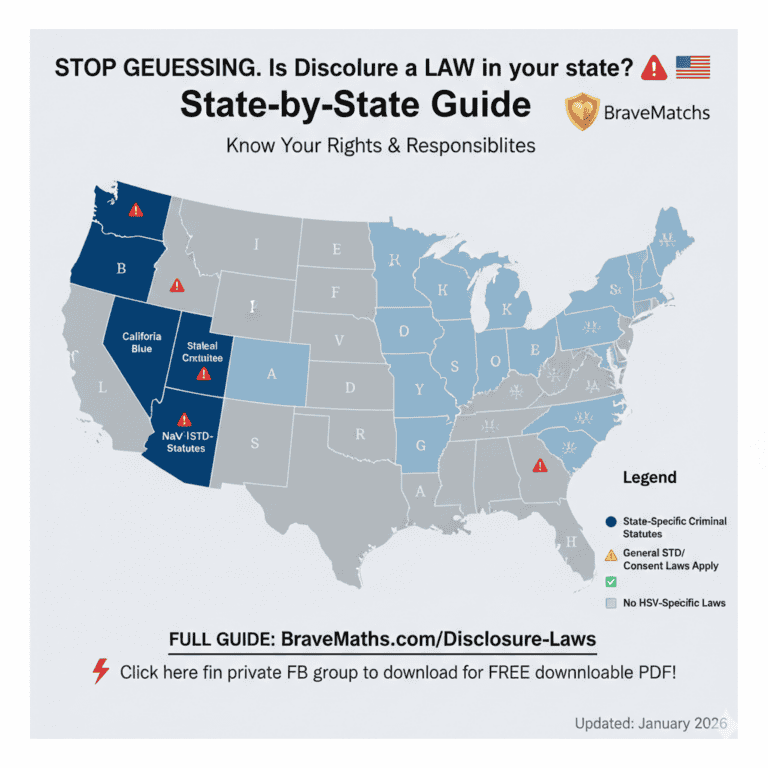
🇺🇸 Summary of HSV Disclosure Obligations and Legal Risks by State
In the United States, there is no single federal law governing herpes disclosure. Instead, it is a patchwork of state-specific statutes and “Common Law” (legal precedents set by judges). Below is a simplified breakdown of how different states approach this issue.
Legal Categorization Table
| Legal Category | Core Legal Logic | Representative States | Recommended Strategy |
| Strict Disclosure Statutes | Laws explicitly mandate the disclosure of STI status before sexual activity. Concealment is a violation of state code. | California (CA), New York (NY), Florida (FL), Oregon (OR) | Disclose before intimacy. In these states, the act of withholding information can be grounds for legal action even if transmission doesn’t occur. |
| Criminalization Statutes | Historically strict laws that view “knowing concealment” as a criminal offense. While often HIV-focused, language can be broad enough to include HSV. | Michigan (MI), Oklahoma (OK), Idaho (ID) | Retain proof of disclosure. Avoid any activity during active outbreaks, as this can be interpreted as “malicious intent” in a criminal context. |
| Civil Negligence Jurisdictions | No specific STI statute, but if transmission occurs, you can be sued for “negligence” looking for massive financial damages. | Texas (TX), Illinois (IL), Washington (WA), Arizona (AZ) | Disclosure equals immunity. Once a partner provides “informed consent,” they “assume the risk,” providing you with a strong civil defense. |
| Common Law / Tort Law States | Statutes are silent on herpes; cases are decided by judges based on general personal injury and “duty of care” principles. | Massachusetts (MA), Pennsylvania (PA), Colorado (CO) | Document preventative measures. Using protection and taking suppressive therapy proves you fulfilled your “duty of care” to minimize risk. |
American Misconceptions About Herpes Disclosure
Some deeply ingrained misconceptions cause unnecessary panic:
“If I have no symptoms, I don’t need to disclose.” Asymptomatic transmission is possible, meaning disclosure is still important.
“I only need to disclose if we are going to have sex.” In reality, disclosure should happen before sexual risk arises, not after.
“The law requires disclosure on the first date.” There is no such regulation. The timing of disclosure should balance honesty with specific circumstances.
“If transmission doesn’t happen, there’s no legal risk.” No transmission reduces risk, but doesn’t eliminate it entirely.
Understanding these misconceptions helps people make decisions based on facts, not fear.
Disclosure decisions often make more sense when viewed alongside the realities of herpes dating in the U.S., including stigma, dating culture, and access to supportive platforms.
Legal Risk vs. Emotional Risk: What Actually Matters in Dating
When dating in the U.S., we often worry that disclosing will ruin the mood, but viewed differently, this is actually your most powerful two shields: one to ward off legal battles, and one to retain the right people.
1. Legal Insurance: Let “Informed Consent” Back You Up
From a legal perspective, honest disclosure is not an admission of guilt; it’s establishing a shared defense mechanism.
Informed Consent: Once the other person chooses to proceed with full knowledge, a “voluntary assumption of risk” is established legally.
Legal Firewall: If, unfortunately, transmission occurs in the future, as long as you can prove you disclosed beforehand, it becomes exponentially more difficult for the other person to sue or claim compensation.
2. Emotional Insurance: The Most Efficient “Jerk Filter”
More important than legal protection is emotional “damage control.” In the fast-paced American dating scene, honesty can save you a lot of wasted time.
Pre-screening: It instantly helps you filter out those who lack empathy or have narrow views.
Goodbye to “Secret Stress”: Dating with a secret is like walking a tightrope; you constantly worry about falling. The moment you speak up, that suffocating anxiety disappears.
Foundation of Trust: The strongest relationships often begin with the hardest truths.
Many American carriers share this experience: It’s better to be rejected when emotions aren’t deeply invested, when you are just having coffee, than to face a “trust crisis” after you are deeply involved or after physical intimacy. Disclosing earlier is actually a huge relief for your mental health.
When Should You Disclose Herpes in the U.S.?
Regarding disclosing herpes in the U.S., many struggle with the “right moment.” Disclosing too early can feel like “TMI” (Too Much Information), while disclosing too late can feel like “deception.” In American dating culture, there’s an unspoken rhythm we usually follow.
1. Finding That “Balance Point”
Most experienced daters choose the following “sweet spot”:
Not just initial small talk: You don’t need to include it in your self-introduction at the first coffee date.
Built on “Mutual Interest”: Disclosure only carries emotional weight when you both have a clear interest in developing the relationship and trust is beginning to grow.
Before “Substantial Contact”: This is the legal and ethical bottom line. Ensure you give the other person enough space to think before clothes come off and risks arise.
2. Why “Timing” Trumps “Speed”?
The law isn’t clocking you; it doesn’t care if you disclosed on day one or day ten. What it does care about is whether you gave the other person complete “informed consent” before they made a life-altering decision (i.e., agreeing to sexual activity).
The key to disclosing herpes isn’t how fast you are, but whether you communicate clearly and respectfully. Communicating like a mature adult in a private, quiet setting not only protects the other person but also demonstrates your high quality as a person dating.
How to Disclose Herpes Without Causing Legal or Emotional Harm
What to Say (and What Not to Say)
In the U.S., effective disclosure usually involves:
Being calm and objective.
Not apologizing or blaming yourself.
Focusing on joint decision-making.
Avoid framing herpes as a confession or a warning. Present it as health information relevant to intimacy.
Text, App, or In Person?
In American dating culture:
In-person disclosure is best once trust is established.
Texting may be appropriate if intimacy is imminent.
Dating apps might allow earlier disclosure, depending on the context.
The method is less important than honesty and timing.
What Happens If You Don’t Disclose and Herpes Is Transmitted?
If you transmit herpes without disclosing, the consequences could include:
Loss of trust and relationship breakdown.
Emotional distress for both parties.
Potential civil liability.
Even if a lawsuit is never filed, the personal costs of non-disclosure often far outweigh the discomfort of open communication.
Conclusion
In discussions about disclosing herpes in the U.S., we often get lost in legal jargon or intimidated by stereotypes on dating apps. But ultimately, proactive disclosure is not about meeting some rigid legal benchmark, nor is it about “apologizing” for your health status.
Instead, it is the highest form of self-protection. While U.S. laws vary by state, the core underlying logic remains unchanged: honesty is the optimal solution for reducing all risks.
Be brave. When you stop concealing, you have already reclaimed control over your life.
Ready to start dating? Check out our review of the [Best Herpes Dating Sites in the U.S.] to find your match.
FAQ
Is it illegal to not disclose herpes in the U.S.?
Not universally. Laws vary by state, and most cases involve civil liability rather than criminal charges.
Can you be sued for not disclosing herpes?
In some situations, yes—particularly if transmission occurs and disclosure did not happen.
Do you have to tell someone before the first date?
No. Disclosure should happen before sexual risk, not necessarily at the first meeting.
Does herpes disclosure law differ by state?
Yes. State laws and court interpretations vary, which is why general awareness matters.