

Introduction
If you’ve just received a herpes diagnosis — or you’ve been living with HSV for a while and are now navigating gay herpes dating for the first time — most of the guides out there weren’t written with you in mind. They use generic language, skip the specific dynamics of LGBTQ+ dating culture, and treat disclosure as a one-size-fits-all conversation that plays out the same way on Grindr as it does on Hinge. It doesn’t. This guide is for gay, bisexual, queer, and trans singles with HSV who want real information: what the prevalence data actually shows, what the double-stigma of being LGBTQ+ and HSV-positive looks like in practice, how disclosure works in gay dating culture specifically, and where to find connection that doesn’t ask you to hide any part of who you are.
In This Article
- How Common Is Herpes in the LGBTQ+ Community
- The Double Stigma — and Why It’s Worth Naming
- Disclosure in Gay Dating Culture
- HSV and HIV: What Gay Men Need to Know
- Where to Actually Meet People
- Frequently Asked Questions
- The Bottom Line
How Common Is Herpes in the LGBTQ+ Community
The first thing most people need after a herpes diagnosis is an accurate picture of how common this actually is — especially within their own community. For gay and bisexual men, the numbers are higher than the general population, and understanding why matters both medically and psychologically.
Quick Stats: HSV Prevalence in LGBTQ+ Communities
| Population / Category | HSV-2 Prevalence & Trends | Source / Authority |
| Men who have sex with men (MSM) | 18.4% (Significantly higher than general male pop) | CDC (NHANES) |
| Heterosexual Men | ~9% | CDC (NHANES) |
| HIV-Positive Gay Men | 30% – 80% (Varies by specific cohort) | Clinical Cohort Studies |
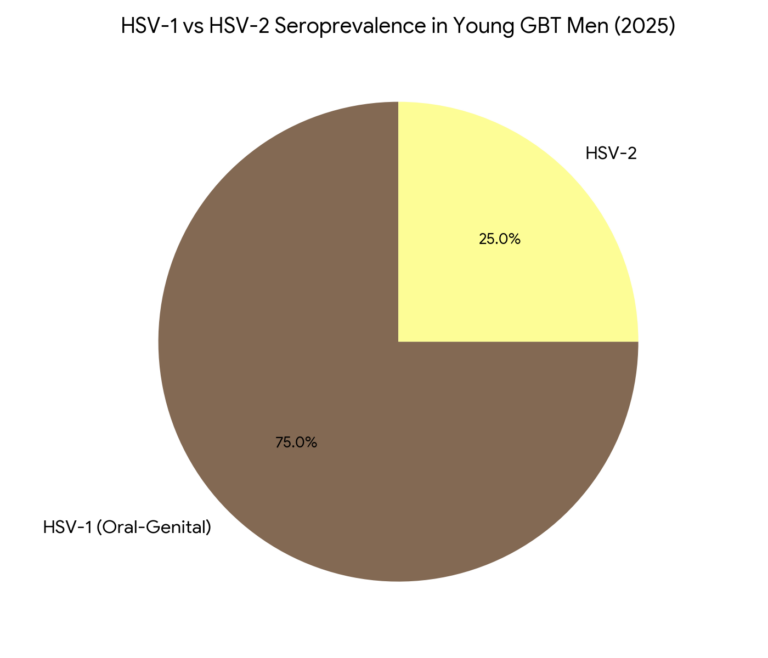
| Young Gay/Bisexual Men | HSV-1 is 3x more prevalent than HSV-2 | 2025 P18 Cohort (AIDS Care) |
| Lesbian & Bisexual Women | Lower HSV-2 transmission risk; HSV-1 comparable to avg. | General Research Review |
| National Average (Ages 14–49) | Approx. 1 in 6 (16.7%) | CDC |
These numbers carry an important implication: in the gay dating community, herpes is not an outlier condition. It is something a significant portion of the people you’re already dating either have or are at risk for — often without knowing it. That changes the calculus of disclosure in ways that most generic guides don’t acknowledge.
The Double Stigma — and Why It’s Worth Naming
Many LGBTQ+ people who receive a herpes diagnosis describe a specific and compounded experience: navigating HSV stigma while already carrying the experience of navigating stigma around sexual orientation or gender identity. These aren’t separate conversations — they interact.
- “Within the gay community, there can be intense pressure around sexual health status — both HIV and HSV. The stigma is real, and it comes from inside the community as well as outside it. But there’s also a much stronger culture of explicit sexual health communication in LGBTQ+ spaces than you’ll find almost anywhere else. That’s a genuine advantage.”
— Observed across LGBTQ+ sexual health advocacy contexts
What this means practically is two things. First, HSV stigma within some gay male spaces — particularly on hookup-oriented platforms — can be more direct and less filtered than in mainstream dating contexts. A swipe left based on a disclosed status happens quickly on some apps. That stings, and it’s worth acknowledging rather than pretending it doesn’t happen.
Second, the LGBTQ+ community has developed sexual health communication norms — around HIV, PrEP, testing dates, status disclosure — that are significantly more sophisticated than in heterosexual dating culture. Many gay men are already accustomed to discussing their testing history before sex. That infrastructure of explicit conversation makes the herpes disclosure conversation easier to have in many LGBTQ+ contexts than people expect.
Community Insight
The same cultural fluency that makes some gay spaces feel harsh around herpes also makes others genuinely more accepting. LGBTQ+ community organizations, sexual health clinics like Howard Brown in Chicago and Fenway Health in Boston, and queer-affirming therapists are equipped to support the specific intersection of identity and diagnosis that mainstream healthcare often misses.
Disclosure in Gay Dating Culture
The mechanics of disclosure in gay dating are shaped by the platforms and norms of the community — and those differ meaningfully from mainstream dating apps.
On apps like Grindr and Scruff
These platforms have a faster pace and more direct sexual communication than most mainstream apps. Many users list their STI testing date, HIV status, and PrEP use directly in their profile — a practice that is normalized and respected in much of the community. Adding your HSV type and management approach (suppressive therapy, last tested) to your profile is an option that removes the disclosure conversation entirely for anyone who messages you — they’ve already read it and chosen to engage. For those who prefer to disclose in conversation, doing so before meeting — rather than in person — is common and generally well-received.
On relationship-oriented apps
Hinge, OkCupid, and similar platforms used by gay and queer singles tend to suit a slightly different disclosure approach: after genuine connection has formed over a few conversations or dates, before physical intimacy. The timing that consistently works best — as with all dating contexts covered in our guide to what to do after a positive herpes diagnosis — is the second to fourth interaction, once interest has established itself but before any physical line is crossed.
What to say
Keep it factual: your HSV type, whether you’re on suppressive therapy, and the actual transmission risk numbers. In a community where sexual health conversations already happen explicitly, this kind of directness tends to land well. You are not confessing — you are communicating clearly, which is exactly what the people worth being with will respect. For the specifics on what those transmission numbers actually mean, our guide to HSV-1 vs HSV-2 dating differences covers the clinical picture in full.
📱 Decoding the Culture: App Lingo & Emojis
In the fast-paced world of Grindr, Scruff, and Sniffies, limited character counts have birthed a unique shorthand. Understanding these “codes” helps you navigate Gay Herpes Dating with more confidence and less anxiety.
“Status-Neutral” / “U=U”: A strong signal of inclusivity. It means the user understands that “Undetectable = Untransmittable” and is likely educated and open-minded regarding HIV and HSV statuses.
“Fully Transparent”: Often placed at the top of a bio, this is an invitation to swap recent testing dates and statuses immediately upon chatting.
💊 (Pill Emoji) / “On PrEP”: Indicates the user takes daily medication to prevent HIV. In the context of HSV, this usually signals a person who is proactive about sexual health and receptive to medical facts.
“DDF” (Drug & Disease Free): A common but controversial term. Many in the community now view this as stigmatizing. If you see this, be prepared that the user may have an outdated or “black-and-white” view of STIs.
“Clean”: Another outdated term (implying those with a virus are “dirty”). More modern, respectful profiles use terms like “Negative,” “Clear,” or “Tested [Date].”
🖼️ Profile Mockup: The “Gold Standard” Example
How do you disclose your status on a profile without it becoming the only thing people see? Here is a “best-practice” mockup that balances personality with transparency.
The Profile Layout
Name: Alex | Age: 28 | Height: 5’10”
Bio: 🌲 Outdoorsy & Coffee obsessed. Looking for someone to explore the city with—from hiking trails to the best bookstores.
Sexual Health & Transparency: 🧪 Last tested: April 2026 🛡️ PrEP: Daily 🌿 HSV-2+ (on daily suppressive therapy) I value honesty and keeping things safe/fun for everyone. Happy to chat about it if you have questions!
Looking For: Dates, Connection, Good vibes.
HSV and HIV: What Gay Men Need to Know
This is the section many gay men want to ask about and find hard to bring up. The relationship between HSV and HIV is real and worth understanding clearly — not as a reason for panic, but as a reason for informed action.
Research has consistently shown that genital herpes approximately doubles the risk of HIV acquisition in gay men — because HSV lesions create mucosal disruption that makes HIV transmission easier in both directions. This is not a reason to add more shame to a diagnosis that already carries enough of it. It is a reason to take two practical steps:
- Suppressive antiviral therapy for HSV reduces both outbreak frequency and subclinical shedding — which in turn reduces the inflammation and mucosal disruption that elevates HIV risk. If you have HSV-2 and are sexually active, suppressive therapy is worth discussing seriously with your doctor, regardless of your HIV status.
- PrEP, if you are HIV-negative and sexually active, remains highly effective regardless of HSV status. HSV-positive gay men are not disqualified from PrEP — in fact, given the elevated transmission risk associated with HSV, PrEP is an especially important tool.
Where to Meet People as an HSV-Positive LGBTQ+ Single
The honest answer is that it depends on what you need right now.
BraveMatchs
Grindr / Scruff
Hinge / OkCupid
Feeld
The pattern that works for many LGBTQ+ people navigating gay herpes dating for the first time is to start in a community where the disclosure conversation has already been had — like BraveMatchs — to rebuild confidence and reconnect with their own desirability in a space that reflects it back clearly. From there, moving to mainstream LGBTQ+ apps becomes a choice made from clarity, not from anxiety about how a conversation might land.
If you’re in Canada and navigating the legal and community context there, our guide to herpes dating in Canada covers the disclosure framework alongside local resources.
FAQ
How common is herpes among gay and bisexual men?
It is significantly more common than in the general population. CDC-based studies show an 18.4% HSV-2 prevalence among MSM, double the rate of heterosexual men. Recent 2025 AIDS Care data also shows HSV-1 is now three times more prevalent than HSV-2 in younger queer men.
How does Gay Herpes Dating work on apps like Grindr or Scruff?
Community norms on these apps favor directness. Many users list their testing dates and PrEP status publicly; adding your HSV type to your profile is a respected way to bypass the “disclosure talk.” On relationship-oriented apps, disclosing between the second and fourth date remains the standard.
Does HSV increase HIV risk for gay men?
Yes. HSV-2 can double HIV acquisition risk due to mucosal disruption. However, using suppressive antiviral therapy to reduce shedding, combined with PrEP, significantly lowers these risks for Gay Herpes Dating and helps maintain a healthy, active sex life.
Is there a specific platform for LGBTQ+ singles with HSV?
Yes. BraveMatchs is fully inclusive of gay, bi, queer, and trans singles. It offers a community-first space where your status is already understood, allowing you to focus on genuine connection without the anxiety of a formal disclosure conversation.
The Bottom Line: You Are More Than Your Status
Navigating the dating world with a diagnosis can feel overwhelming, but in a community that has pioneered sexual health transparency and resilience, you are never alone. Whether you choose to be open on your apps or prefer a more private approach, remember that clear communication is a sign of integrity, not a limitation. By utilizing the right tools and platforms designed for gay herpes dating, you can move past the stigma and focus on what really matters: finding a partner who values you for exactly who you are.
BraveMatchs welcomes gay, bisexual, queer, and trans singles with HSV — across the US, Canada, and Australia. The first conversation here is about connection, not disclosure.