
Medical and legal information in this article was reviewed and updated in May 2026. Laws and public health guidance can change over time; readers should verify current regulations and consult qualified healthcare or legal professionals where appropriate.

Introduce
Ohio doesn’t do ambiguity particularly well. The Buckeye State tends to call things what they are — which, as it turns out, is exactly the right approach to the conversation most people with herpes dread most. Herpes dating in Ohio has a specific legal dimension that sets it apart from many other states: Ohio’s assault statute means that knowingly having sex without disclosing an HSV diagnosis isn’t just ethically wrong, it can be criminally charged. That’s a harder edge than states where the obligation is purely civil — and it’s the kind of information that tends to be missing from the generic “just be honest” advice most guides offer. This article covers what Ohio law actually says, where to get tested in Columbus, Cleveland, and Cincinnati, and what the disclosure conversation looks like when you’re doing it because you genuinely want to — not just because you legally have to.
In This Guide
- Herpes in Ohio: The Numbers Behind the Stigma
- Ohio’s Legal Framework: Why It’s Stricter Than You Think
- Getting Tested in Columbus, Cleveland, and Cincinnati
- Herpes Dating in Ohio: The Disclosure Conversation
- Finding Connection Across the Buckeye State
- Common Questions
Herpes in Ohio: The Numbers Behind the Stigma
Columbus, Cleveland, and Cincinnati each rank among Ohio’s highest-burden STI cities — and the state as a whole has been watching its STI rates climb for years. According to the Ohio Capital Journal, syphilis rates in Ohio rose 82% between 2016 and 2021, a trajectory that mirrors national trends and signals how much undetected sexual transmission is happening across the state. Cincinnati in particular ranked 56th nationally out of 100 major cities for STI burden, with 793 STD cases per 100,000 residents in a recent Innerbody analysis — a figure that reflects the broader picture of STI prevalence in Ohio’s urban centers.
For herpes specifically, the numbers are different in character. Herpes is not a reportable condition to the Ohio Department of Health, which means it doesn’t appear in the same surveillance data as gonorrhea or syphilis. But the CDC’s national estimates — cited consistently in Ohio public health communications — put genital HSV-2 prevalence at approximately 1 in 6 Americans aged 14–49, with up to 90% unaware of their status. In a state of 11.8 million people, that’s an enormous population living with herpes — silently, unknowingly, and often transmitting it to partners who have no idea. The people who know their status, like you, are the minority who have the information to actually do something about it.
A 2024 study in Sexually Transmitted Diseases (Van Wagoner et al.) found that from 2019 to 2021, standardized genital herpes prevalence in the US ranged from 236 to 280 cases per 100,000 person-years. That prevalence is distributed across every city, suburb, and rural county in Ohio — not concentrated in any demographic or geography.
Ohio’s Legal Framework: Why It’s Stricter Than You Think
This is where herpes dating in Ohio requires closer attention than most guides give it. Ohio doesn’t have a law that says “you must disclose herpes.” What it has is significantly more serious.
ORC §2903.13 — Assault.
Ohio defines assault as knowingly causing or attempting to cause physical harm to another person. Ohio criminal defense attorneys at Suhre & Associates explain it this way: if you know you have herpes and engage in sexual contact without telling your partner, you are knowingly attempting to cause physical harm — because you know herpes can be transmitted and you’re choosing not to disclose that risk. Actual transmission is not required for the charge. The knowing exposure itself is sufficient.
This is a meaningful distinction.
In states like Michigan and Illinois, herpes non-disclosure creates civil liability — you can be sued, but you generally cannot be criminally charged. In Ohio, the criminal assault statute has been applied to herpes cases, making non-disclosure a potential misdemeanor or felony charge depending on how a prosecutor constructs the case.
ORC §2903.11 — Felonious Assault.
This statute applies specifically to HIV non-disclosure and carries felony-level penalties. It does not cover herpes directly — but it illustrates Ohio’s general approach: the state treats knowing STI exposure as a form of assault rather than a purely public health matter.
Civil liability also applies.
Beyond the criminal exposure, a partner who contracts herpes after you knew and did not disclose can bring a civil personal injury claim under Ohio tort law. Criminal and civil liability are separate — one does not prevent the other.
The practical takeaway is simple: disclose before sexual contact, every time. Not because Ohio law demands a specific script, but because knowing exposure without disclosure puts you in genuinely precarious legal territory — territory that is more exposed here than in most other Midwestern states. For comparison, our guides to herpes dating in Michigan and Illinois cover how those civil-liability-only frameworks operate differently.
Getting Tested in Columbus, Cleveland, and Cincinnati
A type-specific herpes test — one that separately identifies HSV-1 and HSV-2 — is the first practical step for anyone who hasn’t confirmed their type. It affects your transmission risk profile, your treatment decisions, and the specifics of your disclosure conversation. You’ll need to ask for it explicitly: standard STI panels in Ohio do not include herpes by default.
Columbus
Columbus Public Health Sexual Health Clinic — 240 Parsons Ave, Columbus, OH 43215 · (614) 645-6732 · Walk-ins and appointments · Sliding scale fees
Franklinton Health Center — 1511 West Broad St, Columbus, OH 43222 · (614) 222-3525 · Low-cost STI screening
Equitas Health Columbus — Sexual health counseling and STI testing; affirming care for LGBTQ+ patients and all communities · equitashealth.com
Cleveland
Cleveland Dept. of Public Health — J. Glen Smith Health Center — 11100 St. Clair Ave, Cleveland, OH 44108 · (216) 249-4100
T.F. McCafferty Health Center — 4242 Lorain Ave, Cleveland, OH 44113 · (216) 651-5005 · Walk-ins welcome
Planned Parenthood of Greater Ohio — Cleveland · Full STI panels with explicit herpes test request · plannedparenthood.org
Cincinnati
Hamilton County Public Health STD Clinic — 250 William Howard Taft Rd, Cincinnati, OH 45219 · (513) 946-7600 · Accepts most insurance; sliding scale
Planned Parenthood Southwest Ohio — Cincinnati · Herpes testing available on request · plannedparenthood.org
Marysville
Here for You Sexual Health Clinic — 940 London Ave, Suite 1100, Marysville, OH 43040 · (937) 642-2053 · Serves Union County and surrounding rural areas
Once you have your result — and specifically know whether you have HSV-1 or HSV-2 — the practical implications for dating become clearer. The two types carry meaningfully different transmission profiles and recurrence patterns. Our guide to HSV-1 vs HSV-2 dating differences walks through what each result means for your disclosure conversation and daily management.
Herpes Dating in Ohio: The Disclosure Conversation Done Right
Given Ohio’s legal framework, there’s an extra layer of stakes to the disclosure conversation here. But ironically, the legal pressure isn’t actually what makes people disclose well. The people who have the best outcomes are the ones who’ve gotten to a settled place about their own diagnosis — who understand their type, their transmission risk, their medication status — and who disclose from that position of clarity rather than anxiety.
The timing that works consistently: the second to fourth date. After connection has formed, before any physical line is crossed. In that window, your partner isn’t evaluating a stranger’s medical history — they’re deciding whether to walk away from someone they already like. Those are different decisions, and they go differently.
What the Research Shows
A 2024 survey of more than 1,000 HSV-positive individuals by Something Positive for Positive People (SPFPP) found that 62% had at least one non-positive partner stay in the relationship after disclosure. The people who disclose most effectively are those who come prepared: they know their HSV type, whether they’re on suppressive therapy, and the actual annual transmission risk with and without precautions. Giving someone facts — not just feelings — allows them to make a real decision, and real decisions made from real information are the only ones worth having.
If you’re earlier in the process — recently diagnosed and still working through what this means before you think about dating again — our guide to what to do after testing positive for herpes is the right starting point.
One thing worth saying plainly about Ohio specifically: the assault statute framing of non-disclosure occasionally tempts people to think of disclosure as a legal checkbox to tick rather than an honest conversation to have. That framing produces worse outcomes — both legally and relationally. The goal isn’t to recite a disclosure script to satisfy a statute. It’s to give someone you’re interested in the information they need to make a genuine choice about being with you. Those are different things, and partners can tell the difference.
On suppressive therapy and what it means for herpes dating safety in Ohio
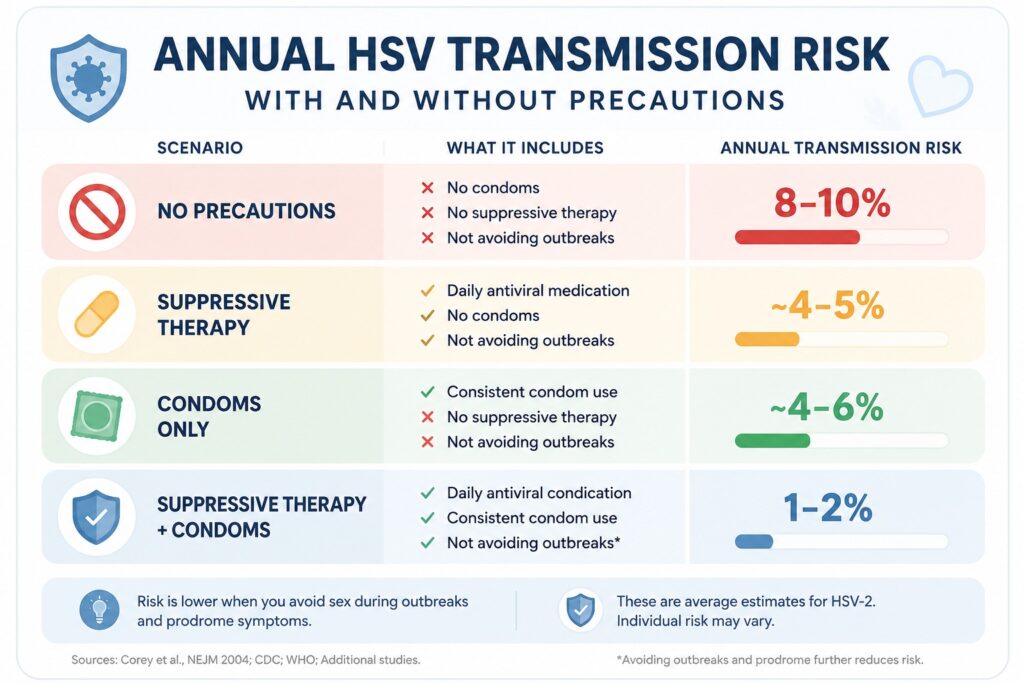
If you’re on daily valacyclovir, that’s meaningful information to include in your disclosure. Research published in the New England Journal of Medicine (Corey et al., 2004) found that daily suppressive therapy reduces HSV-2 transmission risk by approximately 48%, and reduces viral shedding days from 10.8% to 2.9% of days. Combined with consistent condom use, annual transmission risk drops below 2%. These are real numbers that give a partner something concrete to assess — and they tend to land very differently than a disclosure that offers no information at all.
With suppressive therapy + consistent condoms: annual HSV-2 transmission risk approximately 1–2%. Without any precautions: approximately 8–10%. The difference is significant — and it’s information your partner deserves to have.
What We Notice Across Ohio HSV Communities
Across HSV communities and dating discussions, a few patterns tend to come up repeatedly among Ohio singles. These aren’t formal statistics and won’t describe everyone’s experience, but they appear often enough to be worth mentioning.
- Columbus: People often describe the dating scene as faster-moving and more app-driven, partly because of its younger population and large university presence. Conversations may start quickly, but connections sometimes move just as quickly.
- Cleveland: Dating experiences often feel more connected to existing social networks. Overlapping friend groups and long-established communities can make disclosure feel more personal, but they can also create stronger long-term relationships.
- Cincinnati: Many singles describe a slightly slower pace. Conversations often continue longer before meeting in person, which can give disclosure discussions more room to happen naturally.
One thing appears consistently across all three cities: people who understand their diagnosis and feel comfortable talking about it tend to report better dating experiences than those trying to avoid the conversation entirely.
Finding Connection Across the Buckeye State
Ohio’s three major cities each have their own dating culture, and HSV-positive singles navigate each a little differently. Columbus — younger, fast-growing, with a large Ohio State University population that keeps the dating pool transient and app-heavy — tends toward Hinge and Bumble as the dominant platforms for relationship-oriented dating. Cleveland has a more rooted, neighborhood-based social culture; the city’s Catholic school network and longstanding ethnic communities mean that social circles overlap in ways that make word-of-mouth introductions at least as common as apps. Cincinnati sits somewhere between the two — more conservative socially than Columbus, with a strong arts and food scene that draws a younger professional demographic to neighborhoods like Over-the-Rhine and Hyde Park.
For some people, mainstream apps work well. Others prefer communities where HSV status is already understood before the first conversation begins. BraveMatchs is one option designed specifically for HSV-positive singles who want to reduce disclosure anxiety and focus on compatibility first.
Common Questions About Herpes Dating in Ohio
Can you sue someone for giving you herpes in Ohio?
In some situations, yes. A person who believes they contracted herpes from a partner who knew their HSV status and did not disclose it may pursue a civil claim under Ohio personal injury principles. Outcomes depend on evidence, disclosure history, timing, and the specific facts of the case. Legal situations vary, so professional advice may be appropriate for individual circumstances.
Is herpes testing included in a regular STD panel in Ohio?
Usually not. Most standard STI panels focus on infections such as chlamydia, gonorrhea, syphilis, and HIV. Herpes blood testing is commonly offered separately and often requires a specific request. If you’re concerned about HSV, ask for a type-specific IgG test that distinguishes between HSV-1 and HSV-2.
Can I date normally if I have herpes in Ohio?
Yes. Many people with HSV continue dating, enter long-term relationships, get married, and build families. Understanding your diagnosis, discussing transmission honestly, and taking appropriate precautions often makes dating feel more manageable over time.
Does daily antiviral medication reduce herpes transmission risk?
Daily suppressive antiviral therapy can reduce HSV transmission risk and lower the frequency of viral shedding. Combined with consistent condom use and avoiding sexual contact during outbreaks, the overall risk can decrease significantly compared with taking no precautions.
Do Ohio colleges and universities offer STI testing?
Many colleges and universities in Ohio provide STI screening through campus health services, although herpes testing may not be included automatically. Students should ask whether type-specific HSV testing is available and whether outside referral options are offered.
How long should I wait before telling someone I have herpes?
There is no universal rule, but many people choose to disclose after some connection has developed and before physical intimacy begins. The goal is giving the other person enough information to make an informed decision while allowing the conversation to happen naturally.