

Most people, when they imagine telling someone new that they have herpes, run the worst version of that conversation on a loop in their head. The shock. The silence. The pulled-back chair. What they rarely imagine is what actually tends to happen — which is more complicated, more human, and considerably less catastrophic than the script they’ve rehearsed. This article is a collection of real herpes dating success stories — not the curated testimonials you’ll find behind a paywall on a dating platform, but honest accounts of what disclosure actually looked like, what happened when it went badly, and what happened when it led somewhere neither person expected.
At the end, there are five patterns that show up across every story that works. Those patterns are the part worth reading twice.
- First — What the Numbers Actually Show
- Story 1: Maya, 38, Texas — The Third-Date Car Conversation
- Story 2: James, 44, Toronto — Rejection That Led Somewhere Better
- Story 3: Priya, 51, California — Married, Discordant, and Thriving
- What These Stories Have in Common
- If You Haven’t Started Yet
- FAQ
The Reality Gap: What the Science Says About Disclosure
Most people overestimate the risk of rejection. When we look at the clinical data and community surveys from 2024, a much more hopeful picture emerges.
The Statistics of Acceptance
A massive survey of over 1,000 HSV-positive individuals conducted by Something Positive for Positive People (SPFPP) revealed that rejection is far from the norm:
62% Acceptance Rate: The majority of respondents had at least one non-positive partner choose to move forward with a sexual relationship after disclosure.
66% Informed Consent: Over two-thirds of non-positive partners felt comfortable enough with the facts to consent to sex without barrier protection.
The Takeaway: These aren’t just “lucky” outliers—these are the standard outcomes for people who communicate clearly and honestly.
Managing the Risk: The Math of Safety
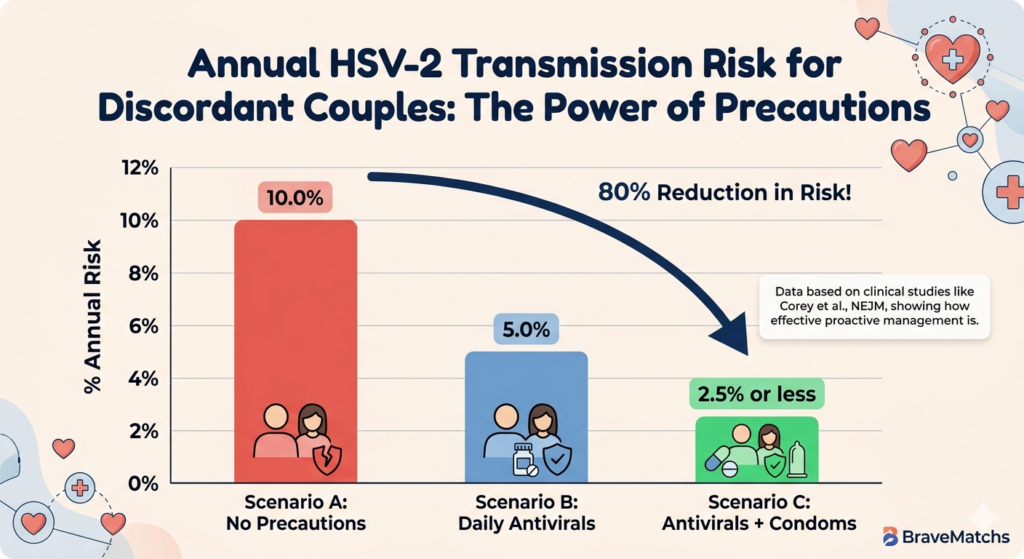
For discordant couples (where one partner is positive and the other is not), the risk is not a “guessing game”—it’s a manageable calculation.
| Protection Method | Risk Reduction Factor | Source |
| Daily Suppressive Therapy | Reduces transmission risk by ~48% | New England Journal of Medicine |
| Consistent Condom Use | Provides significant additional protection | Clinical Guidelines |
| Combined Approach | Reduces annual risk to its lowest possible level | Corey et al. |
Herpes Dating Success Stories
Story One–The Third-Date Car Conversation
Maya had dated three people since her diagnosis. The first two she told on the first date — too early, too much pressure on both sides, too much information before there was any reason to care about each other. The third she waited too long with, until things had already moved physically, and that conversation ended badly for reasons she understood but still regretted.
By the time she met Chris — divorced, a project manager, met through a mainstream app — she had thought carefully about when and how. She decided: after the third date, before anything physical happened, in a semi-private setting where neither of them would feel cornered.
The third date ended in a parking lot at 11pm. She turned to face him and said something close to: “Before this goes anywhere, I want to tell you something. I have HSV-2. I’ve had it for three years, I take daily medication, and the transmission risk with precautions is well under 2% per year. I’m not asking you to decide anything right now — I just think you should have that information.”
“He didn’t say anything for about ten seconds, which felt like a year. Then he asked: ‘How do you manage it day-to-day?’ That was his first question. Not ‘how did you get it,’ not ‘are you contagious right now.’ He wanted to understand what it actually meant.”
Chris sent a message the next morning that said he’d looked it up overnight and had some more questions if she was open to it. They talked for an hour on the phone. He stayed. Eighteen months later they were living together. As of last year, Chris remains HSV-negative.
Maya’s read on what happened: “I think the timing mattered a lot. By the third date, he already liked me. He wasn’t evaluating a diagnosis in the abstract — he was evaluating whether this particular thing was something he could work with for someone he was already interested in. Those are very different calculations.”
What Maya’s Story Shows
Disclosure timing is not just etiquette — it’s strategy. By the third date, connection has formed. The person across from you is no longer evaluating a stranger’s medical history; they’re deciding whether to walk away from someone they’ve already started to like. That’s a meaningfully different decision, and it goes differently. Maya’s preparation also mattered: she gave Chris facts, not just feelings — her HSV type, her medication, the actual numbers. His first instinct was curiosity, not panic, partly because she hadn’t panicked.
Story Two-Rejection That Led Somewhere Better
James was diagnosed with genital HSV-1 — transmitted through oral sex — about a year and a half before the events he describes. He’d done the reading. He understood his type carried a lower recurrence rate than HSV-2 and that genital shedding of HSV-1 decreases significantly after the first year. He felt, if not confident, at least informed.
He met a woman through Hinge — a graphic designer, funny, shared his taste in films — and they went on four dates before he told her. She was warm in the moment. She said she needed time to think. Two weeks passed. Then a short message: she had thought about it, she liked him, but she wasn’t able to move forward with the risk. She was sorry.
A friend who knew his situation suggested he look at platforms built specifically for HSV-positive singles. James resisted — it felt like giving something up. Eventually he joined BraveMatchs.
Within three weeks he was talking to Rachel. Also HSV, also Toronto, also in her 40s, also divorced. Their first date lasted four hours. Their second date ended with plans for a third. There was no disclosure conversation — because there was nothing to disclose.
James and Rachel have been together for fourteen months. He’s still on BraveMatchs as a success story, which he finds slightly embarrassing and also kind of perfect.
What James’s Story Shows
Rejection is painful and it’s real — James’s story doesn’t skip that part. But the rejection also pushed him toward something he’d been avoiding, and what he found there was better than what he’d lost. His experience is one version of a pattern that comes up constantly in the HSV community: the people who treat a rejection as information rather than a verdict tend to end up somewhere better. And the platform choice matters — not because mainstream apps are wrong, but because a community where the disclosure conversation has already happened clears space for the relationship to be about everything else.
Story Three-Married, Discordant, and Four Years In
Priya had been living with HSV-2 for seven years when she met David through a mutual friend at a dinner party. She had disclosed to three people before David. Two had stayed. One had left. By that point, she describes her attitude toward the conversation as “not comfortable exactly, but workmanlike — I knew how to do it.”
She waited until the fourth date. A coffee shop on a Saturday afternoon — neutral ground, daytime, no pressure of what might happen after. She came prepared with three things: her HSV type, her medication status, and the actual transmission statistics.
The numbers she gave him were accurate: for an HSV-2-discordant couple, without precautions, annual transmission risk is approximately 8–10%. With daily suppressive therapy, that drops to around 4–5%. Add consistent condom use and the risk decreases further. She didn’t minimise. She explained.
David is a software engineer. He approached it the way he approaches most things — analytically, without drama. He did his own reading that week. He asked three more questions over the following days, all of them factual. Then he said he wanted to continue.
They married two years later. Priya has been on daily suppressive therapy throughout. David has been tested annually and remains HSV-negative. They have never had a serious conversation about whether the relationship was worth the risk — because they had that conversation once, at the beginning, and David made a choice from a position of real information.
What Priya’s Story Shows
Priya gave David the actual numbers, not a softened version. And that precision was what made his decision feel real to both of them. A partner who says yes because they fully understand the risk is a more solid foundation than a partner who says yes because you downplayed it. The disclosure conversation isn’t just about getting permission to continue — it’s the first act of the relationship’s actual honesty. Couples who handle that conversation well tend to handle everything else better too.
What These Stories Have in Common
Three people, three different situations, three different outcomes — and five things that were true in all of them when things eventually worked.
1.Timing around the second to fourth date.
Not the first — too early, before connection exists to give context. Not in the heat of the moment — too much pressure, too little space to think. The window where genuine interest has formed but no physical line has been crossed is the window where the conversation consistently goes best.
2.Factual preparation made a difference.
In every story above, the person disclosing knew their HSV type, their medication status, and the actual transmission risk numbers. That information transforms the conversation from an emotional confession into an adult exchange of facts. It also signals to the other person that you take this seriously and have done the work — which is itself reassuring. For a clear breakdown of the differences between HSV-1 and HSV-2 in dating contexts, see our guide to HSV-1 vs HSV-2 dating differences.
3.Calm delivery, without excessive apology.
None of the three people above began with “I’m so sorry to have to tell you this.” They stated the facts clearly, offered to answer questions, and gave the other person space to respond. Disclosure delivered from a place of shame tends to signal that the condition is shameful — and that signal affects the response. Disclosure delivered matter-of-factly signals that this is manageable information, which it is.
4.Rejection was treated as information, not verdict.
James’s story is the clearest example: one rejection, processed honestly, led to a better outcome than the relationship he’d lost. The people who date successfully after a herpes diagnosis are not the ones who never got rejected. They’re the ones who understood that a rejection tells you about that person, at that moment — and nothing more permanent than that.
5.Platform choice affected the whole experience.
James’s shift to a dedicated HSV community removed an entire layer of anxiety from his dating life. Priya, who disclosed on mainstream platforms, had also done that successfully — so this is not a rule, it’s an option. But for people in the early period after diagnosis, or anyone who finds the disclosure conversation consistently draining, a community where that conversation has already happened is a meaningful change in how dating feels day to day.
If You Haven’t Started Yet
The question people ask most often isn’t “does herpes dating work” — they can see that it does. The question is “where do I begin.”
If you received your diagnosis recently and you’re not ready to date yet — that’s fine. Give yourself time to reach a settled place before you add the disclosure conversation to your life. Our guide to what to do after testing positive for herpes is the better starting point for right now.
If you’re ready to date but anxious about disclosure — do the reading first. Understand your HSV type, your transmission profile, how suppressive therapy affects your situation. Our guide to HSV-1 vs HSV-2 dating differences covers those specifics in full, and our piece on STD testing and dating addresses the broader picture of sexual health honesty in new relationships.
If you want to start somewhere the disclosure conversation isn’t the first obstacle — BraveMatchs is built for that. A community where everyone already understands means the first conversation can be about whether you actually like each other. Which is, in the end, the only question that matters.
Expert Insight: Reframing the Conversation
“The most successful disclosures aren’t just about sharing a diagnosis; they are about building a foundation of radical honesty. When a person presents the facts calmly and allows space for their partner’s questions, they aren’t just managing a virus—they are demonstrating the kind of maturity and integrity that healthy, long-term relationships are built on.”
— Dr. Logan Levkoff, Ph.D., Relationship Expert and Sexuality Educator
Key Resources for Informed Dating
To help you and your partner make the most informed and evidence-based decisions, we have curated these essential resources from the world’s leading medical organizations:
CDC: Genital Herpes – CDC Fact Sheet The global gold standard for sexual health guidance, covering herpes basics, transmission routes, and the latest prevention strategies.
The American Sexual Health Association (ASHA): Herpes Provides highly practical communication tips to help ease disclosure anxiety and learn how to initiate positive conversations about sexual health.
The New England Journal of Medicine (NEJM): Transmission Study The original clinical study confirming that daily suppressive therapy reduces the risk of transmission by 48%.
FAQ: Navigating Love and Relationships with HSV
Can you find love through Herpes Dating Success Stories?
Yes. Data shows 62% of people find acceptance from non-positive partners after disclosure. A diagnosis doesn’t stop love; it simply shifts the conversation toward honesty and intentionality.
How often do people accept herpes disclosure?
More often than you’d expect. Rejection is statistically less common than people fear, and the outcome depends more on your timing and confidence than the diagnosis itself.
Should I only date other HSV-positive people?
It’s a personal choice. Many prefer dedicated sites like BraveMatchs to skip disclosure, while others find their own herpes dating success stories in discordant relationships using proper precautions.
What should I do if someone rejects me?
Treat it as a reflection of their current comfort level, not your worth. Rejection is often a redirection toward a partner who is better informed and more compatible with your reality.
Does herpes affect long-term relationship quality?
Rarely. With daily medication reducing transmission risk by 48% and condoms providing extra safety, most couples find that the early honesty required actually creates a deeper, more grounded bond.
The Version You Haven’t Written Yet
The stories above are not exceptional. They are three versions of what tends to happen when people stop letting the fear of disclosure be larger than the actual conversation — when they do the reading, pick the right moment, and say what’s true, plainly.
Some conversations go badly. James’s first one did. That’s in the data too. But the herpes dating success stories that end with “and we’ve been together four years” are not reserved for people who were somehow spared the difficult parts. They’re the stories of people who got through the difficult parts and kept going.
Yours could be one of them.