
By BraveMatchs Editorial Team · May 2026 · Dating With Herpes · Sexual Health
Most people who start taking daily suppressive therapy leave the doctor’s office with a prescription and almost no useful information about what it actually does. Some assume the medication makes them effectively non-contagious. Others assume it only manages outbreaks and has little impact on transmission. Both misunderstandings matter — because herpes dating safety isn’t a feeling you arrive at by hoping for the best. It’s a set of specific, well-documented numbers that allow you and the people you date to make real decisions from real information. This guide is about those numbers: what suppressive therapy does to viral shedding, how condoms change the equation further, and how to translate all of it into a conversation that actually serves both people in the room.
In This Article
- The Concept Most Guides Skip: Viral Shedding
- What Suppressive Therapy Actually Does — Layer by Layer
- The Transmission Risk Numbers in Plain Language
- Why Medication and Condoms Work Better Together
- Bringing These Numbers Into the Disclosure Conversation
- Common Concerns About Long-Term Medication
- Frequently Asked Questions
The Concept Most Guides Skip: Viral Shedding
To understand what suppressive therapy does — and doesn’t do — you first need to understand viral shedding, which is the mechanism through which herpes is actually transmitted most of the time.
Viral shedding is what happens when the herpes virus reactivates from the nerve ganglia, travels to the skin surface, and becomes present there in detectable levels — whether or not any visible symptoms appear. When shedding is happening without symptoms, it’s called asymptomatic shedding, and it’s responsible for the majority of herpes transmissions. Not the outbreaks. The days when nothing feels different at all.
Research by Dr. Anna Wald and colleagues at the University of Washington — cited extensively in the CDC’s STI Treatment Guidelines — found that people with genital HSV-2 shed the virus on approximately 10–33% of days when no outbreak is present, depending on how recently they were infected and their individual viral load profile. For genital HSV-1, that figure is significantly lower — closer to 5% of days — which is one of the reasons the two types carry meaningfully different transmission profiles. Our guide to HSV-1 vs HSV-2 dating differences covers what those differences mean in practice for your dating life.
The reason this matters is that suppressive therapy works primarily by reducing shedding — not by preventing outbreaks alone. When you understand that mechanism, the rest of the numbers make sense.
Herpes Dating Safety: What Suppressive Therapy Actually Does — Layer by Layer
Suppressive therapy means taking an antiviral medication daily — typically valacyclovir 500mg, acyclovir, or famciclovir — rather than only during an outbreak. Its effects operate on three distinct levels, each of which contributes to safer dating.
Layer one: Outbreak frequency
According to the CDC’s 2021 STI Treatment Guidelines, suppressive therapy reduces the frequency of genital herpes recurrences by 70–80% in people who have frequent outbreaks. Many people on daily medication report no symptomatic outbreaks at all during treatment. Fewer outbreaks means fewer high-shedding episodes — but more importantly, suppressive therapy’s benefits extend far beyond just outbreak prevention.
Layer two: Viral shedding reduction
This is where the transmission-relevant data lives. The landmark Corey et al. trial published in the New England Journal of Medicine (2004) followed 1,484 discordant couples — one partner with symptomatic HSV-2, one susceptible — over eight months. Among the findings: daily valacyclovir reduced viral shedding days from 10.8% of days to 2.9% of days. That’s a roughly 73% reduction in the days when the virus is detectable on the skin surface — the primary window for transmission.
Layer three: Transmission risk reduction
In the same trial, daily valacyclovir reduced symptomatic HSV-2 transmission to a susceptible partner by 75% (from 16 cases to 4 in the placebo vs. treatment group). Overall acquisition risk — including those who became infected but showed no symptoms — dropped by 48%, from 3.6% to 1.9% per year. That figure — roughly 48% overall risk reduction — is the one most often cited, and it’s important to understand what it means: starting from an already relatively low baseline, daily medication cuts that risk approximately in half again.
Suppressive therapy does not eradicate the virus — it reduces how active it is. When medication is stopped, the protective effect ends. The virus remains latent in the nerve ganglia regardless of treatment duration. This is not a reason to avoid treatment; it’s a reason to understand what you’re managing and to discuss with your doctor whether and when it makes sense to continue.
The Transmission Risk Numbers in Plain Language
The following figures are drawn from the Corey et al. NEJM trial and subsequent analyses, including data compiled by HerpesOpportunity’s transmission rate research. They apply to heterosexual, HSV-2 discordant couples. Same-sex couples and HSV-1 scenarios have different profiles — discussed in the FAQ below.
| Scenario | Approximate Annual HSV-2 Transmission Risk |
|---|---|
| No precautions (no medication, no condoms) | ~8–10% |
| Condoms only (consistent use) | ~4–5% |
| Daily suppressive therapy only | ~4–5% |
| Suppressive therapy + consistent condoms | ~1–2% |
| Suppressive therapy + condoms + avoiding sex during outbreaks | <1% |
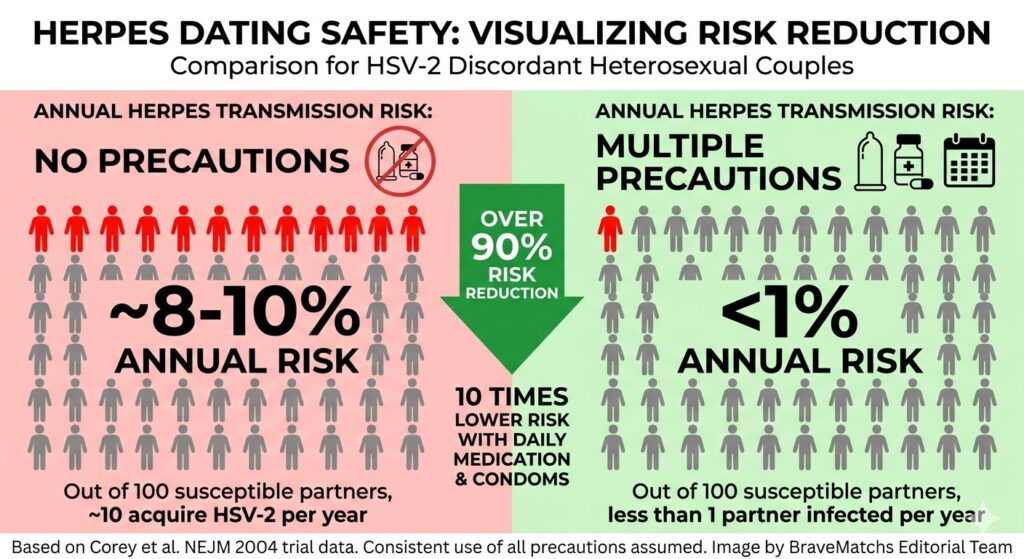
A few things the table doesn’t show, but that matter for herpes dating safety: transmission direction affects these numbers (male-to-female transmission is higher than female-to-male); HSV-1 genital transmission risk is lower across all scenarios; and these figures assume consistent use of the precautions listed — inconsistent condom use or missed medication doses change the picture.
Why Medication and Condoms Work Better Together
A common question is whether taking daily suppressive therapy means condoms are no longer necessary. The short answer is no — and understanding why reveals something important about how these protections actually work.
How Suppressive Therapy Protects
Reduces the amount of virus replicating and shedding on skin surfaces. Fewer shedding days means fewer windows of transmission risk. Works systemically — throughout the entire potential shedding area.
How Condoms Protect
Create a physical barrier between skin surfaces during the covered area. Do not cover all potential shedding zones (inner thighs, buttocks, base of penis) but significantly reduce transmission from covered areas. Work independently of viral load.
Because they work through entirely different mechanisms, their effects are additive rather than redundant. The CDC’s STI Treatment Guidelines explicitly recommend suppressive therapy “as part of a strategy for preventing transmission, in addition to consistent condom use” — not as an alternative to it. Avoiding sex during outbreaks adds a third independent layer, since active lesions shed the virus at a significantly higher rate than asymptomatic skin. Together, these three practices represent the most protective combination currently available for herpes dating safety in discordant relationships.
Bringing These Numbers Into the Disclosure Conversation
Knowing the numbers is only useful if they make it into the conversation — and the way you bring them in matters as much as having them at all.
Most people approach the herpes disclosure conversation emotionally, which makes sense given how charged the diagnosis feels. But what partners often actually need is information — real numbers that allow them to make a genuine decision about their own risk. A partner who understands that annual transmission risk with two layers of protection sits below 2% is in a fundamentally different position than one who’s just been told “I have herpes, but I take medication.”
The specific language doesn’t need to be clinical. Something close to this tends to work:
Example Disclosure Language:”Before we take this further, I want to be upfront with you — I have HSV-2. I take daily valacyclovir, which cuts transmission risk by about 48% on its own. With that plus a condom, the annual risk drops to around 1–2%. I’m not asking you to decide right now — I just want you to have the actual numbers so we can figure out what this looks like together.”
The calm, factual delivery is doing real work here. As the stories in our guide to herpes dating success stories show consistently, partners who receive information — rather than apology — tend to respond with curiosity rather than panic. The person across from you can only make a real decision if you give them real information to decide with. That’s what herpes dating safety looks like in practice — not the absence of risk, but the presence of honesty about what the risk actually is.
If your partner wants to understand their own current status before deciding, our guide to STD testing and dating covers how to approach that conversation and what testing they’d actually need.
Common Concerns About Long-Term Medication
People on suppressive therapy — or considering it — consistently raise the same questions. Here they are, with straight answers.
Do I need to stay on medication indefinitely?
Not necessarily. The CDC recommends that doctors discuss annually whether patients want to continue suppressive therapy, because HSV-2 recurrence frequency naturally decreases over time for many people. If you’re in a discordant relationship, stopping medication means losing the transmission protection it provides — which is worth factoring into that conversation with your doctor.
Is it safe to take valacyclovir every day long-term?
Yes. According to the Cleveland Clinic Journal of Medicine (2024), long-term safety and efficacy have been well-documented for acyclovir, valacyclovir, and famciclovir. Adverse events and development of antiviral resistance related to long-term use are uncommon. Routine laboratory monitoring is not required for most patients on suppressive therapy.
Does taking medication mean I don’t need to disclose?
No. Suppressive therapy reduces transmission risk substantially — it does not eliminate it. Your partner’s right to make an informed decision about their own health exists regardless of your viral load or medication status. Ethically, and legally in most US states and Canada, disclosure before sexual contact remains the standard.
Does suppressive therapy work the same way for HSV-1?
Not quite. The Cleveland Clinic Journal of Medicine (2024) notes that current data do not show a clear benefit of chronic suppressive therapy specifically for patients with recurrent HSV-1 infection. Because genital HSV-1 has significantly lower shedding rates and recurrence frequency than HSV-2 after the first year, the transmission risk profile is meaningfully different. Whether suppressive therapy makes sense for genital HSV-1 is worth discussing with your doctor individually.
What if I’m dating someone who also has herpes?
If both partners have the same HSV type, transmission of that type between you is not a concern. If you have different types — one HSV-1, one HSV-2 — there is still a theoretical possibility of transmission to a new anatomical site, though the clinical significance is generally low. This is another conversation worth having with your doctor once you know both partners’ types. And on platforms like BraveMatchs, where the community is built around people who already live with HSV, this conversation often happens naturally rather than as a weighted disclosure.
Frequently Asked Questions About Herpes Dating Safety
Does suppressive therapy make herpes safe to date with?
It makes it significantly safer — not zero-risk, but meaningfully low-risk when combined with other precautions. Daily valacyclovir reduces HSV-2 transmission risk by approximately 48%, and reduces viral shedding days from 10.8% to 2.9%. Combined with consistent condom use and avoiding sex during outbreaks, annual transmission risk drops to roughly 1–2%. Herpes dating safety is about layered, informed risk reduction.
What is the actual transmission risk of herpes with daily medication?
With daily suppressive therapy (valacyclovir 500mg), HSV-2 annual transmission risk in heterosexual discordant couples is approximately 1.9% — down from 3.6% without medication, per the Corey et al. NEJM 2004 trial. Adding consistent condom use brings this below 1–2%. Without any precautions, the annual risk is approximately 8–10%.
Do I still need condoms if I take valacyclovir every day?
Yes — they work through different mechanisms and their effects are additive. Suppressive therapy reduces viral shedding; condoms create a physical barrier. The CDC recommends suppressive therapy as part of a combined strategy alongside consistent condom use — not as a replacement for it.
Does suppressive therapy work differently for HSV-1 vs HSV-2?
Yes. The strongest clinical evidence for transmission risk reduction is for genital HSV-2. Cleveland Clinic Journal of Medicine (2024) notes that current data do not show a clear benefit of chronic suppressive therapy for HSV-1 recurrences specifically. Genital HSV-1 has lower shedding rates and recurrence frequency after the first year, making the risk profile meaningfully different. See our guide to HSV-1 vs HSV-2 dating differences for a full breakdown.
Can I stop taking herpes medication after a few years?
Possibly. The CDC recommends annual discussions about whether to continue suppressive therapy, because HSV-2 recurrence frequency naturally decreases over time for many people. Long-term safety of acyclovir, valacyclovir, and famciclovir is well-documented. If you’re in a discordant relationship, stopping medication means losing the transmission protection it provides — factor that into the conversation with your doctor.
The Point of Having These Numbers
The transmission risk figures in this article are not meant to make herpes feel like a mathematical exercise. They’re meant to give you — and the people you care about — something concrete to stand on when the disclosure conversation happens.
Most of the fear around herpes dating safety lives in the unknown. In the abstract, a herpes diagnosis sounds dangerous. In the specific — 1–2% annual risk with two layers of protection, falling to below 1% with a third — it becomes something two adults can actually reason about together. That’s a very different conversation than the one most people dread.
The people in our guide to herpes dating success stories are not people who found partners willing to ignore the risk. They’re people who gave their partners real information — and found that real information, honestly shared, was something most people were capable of handling.