
Last updated: May 2026 | Reading time: ~9 minutes
Quick Answer
People with herpes can absolutely use mainstream dating apps, but most platforms provide little support for disclosure, education, or community. For many users searching for a herpes dating app, this gap creates frustration and uncertainty. It often increases anxiety around transparency and reinforces stigma for HSV-positive users. Dedicated HSV dating communities may help, but many come with their own limitations.
Introduction
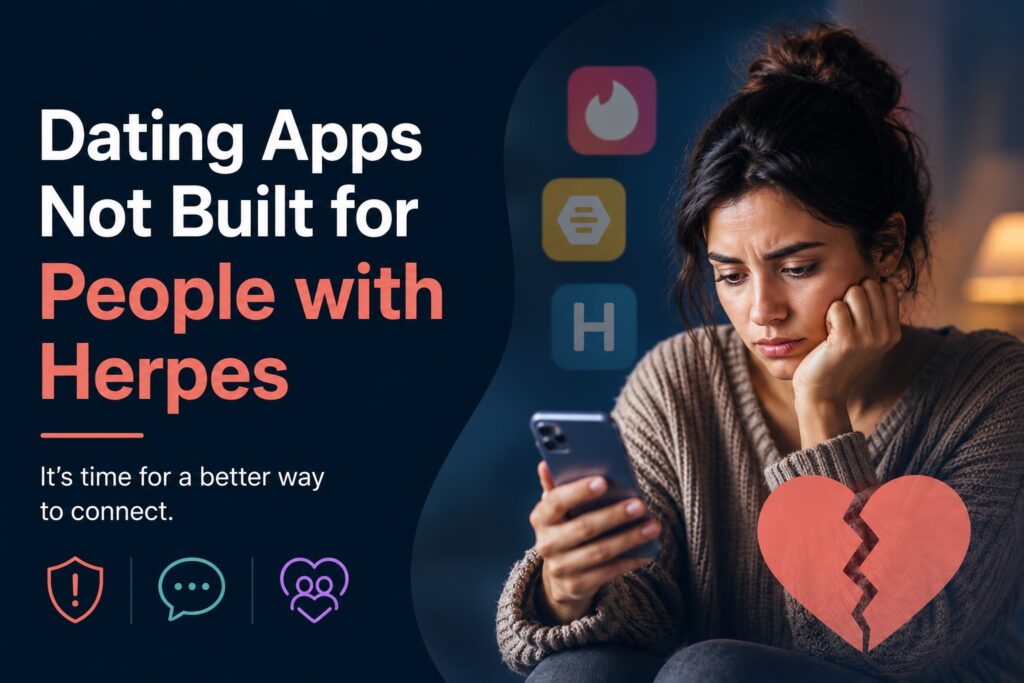
Let’s be honest about something most people won’t say out loud: if you have herpes and you’re trying to date, mainstream apps were not built with you in mind. Not Tinder. Not Bumble. Not Hinge. They weren’t designed to be hostile — they just weren’t designed for you at all. And for millions of people living with HSV-1 or HSV-2, that distinction barely matters when you’re staring at a blank bio wondering how, or whether, to say something.
This isn’t about blaming apps for a virus. It’s about an honest look at how the biggest herpes dating app alternatives — the mainstream platforms — quietly create conditions where HSV-positive people are left to navigate disclosure, stigma, and rejection entirely on their own, with zero structural support. And why that gap matters more than most people realize.
The Scale of the Problem Nobody Talks About
Here’s a number that might surprise you: according to the World Health Organization, an estimated 3.7 billion people under the age of 50 — roughly 67% of the global population — carry HSV-1. HSV-2 affects approximately 491 million people aged 15–49 worldwide. That’s not a niche condition. That’s most of the people swiping on the same apps you are.
Yet open any mainstream dating app and you’ll find zero space to acknowledge this reality — no health status fields, no community resources, no built-in guidance on disclosure. The apps are essentially asking HSV-positive users to pretend the conversation doesn’t exist until it urgently does.
This silence isn’t neutral. It actively shapes how people with herpes experience online dating — and rarely in a good way.
How Mainstream Apps Set HSV-Positive Users Up to Fail
1. The Disclosure Dilemma Has No Good Answer
When you’re using a mainstream herpes dating app alternative like Tinder or Bumble, you face an impossible choice early in every potential connection: disclose your status in your bio (and watch your match rate tank), disclose it early in conversation (and risk immediate ghosting before anyone gets to know you), or wait until you feel a real connection has formed (and then carry the anxiety of that pending conversation for weeks).
None of these options are good. All of them put the entire emotional burden on the HSV-positive person. The app offers no framework, no language, no timing guidance. You’re on your own.
Research published in Sexually Transmitted Infections found that stigma and fear of rejection are the primary reasons people with STIs delay or avoid disclosure — and that this delay is directly linked to worse mental health outcomes, not just transmission risk. In other words, the pressure these platforms create by offering no support isn’t just emotionally uncomfortable — it has measurable consequences.
2. The Reporting System Can Be Weaponized
This one doesn’t get talked about enough. On most major dating apps, users can report profiles for “inappropriate content.” The community guidelines are intentionally vague. There’s no carve-out that says “disclosing a health condition in your bio is not a reportable offense.”
What that means in practice: some HSV-positive users who are transparent about their status in their profile have had their accounts flagged and suspended — not because they violated any stated rule, but because another user found the disclosure uncomfortable and hit “report.” The platform’s automated systems can’t distinguish between a harassment attempt and someone honestly disclosing a health condition.
The result is a chilling effect. People learn, quickly, that honesty may get them removed. So they hide, or they leave.
3. The Algorithm Doesn’t Understand Context
Mainstream apps optimize for engagement and matches. Their algorithms reward profiles that generate right-swipes and conversations. An HSV-positive person who discloses their status — even thoughtfully, even in the most non-alarmist way possible — will almost certainly see lower engagement metrics than someone who doesn’t.
Lower engagement means the algorithm shows your profile to fewer people. So you’re not just dealing with individual rejection; the system itself is quietly deprioritizing your visibility. Not out of malice — out of pure optimization logic that was never designed with your situation in mind.
The “Just Use a Herpes-Specific App” Problem
The obvious counterargument is: well, just use a dating app made for people with herpes. And yes, those platforms exist — Positive Singles being the most well-known. But this solution comes with its own serious problems that aren’t discussed nearly enough.
Dr. Maggie Dancel, a clinical psychologist specializing in sexual health, has noted that being pushed toward HSV-only spaces can reinforce the very shame that makes the diagnosis so difficult — sending the message that people with herpes belong in a separate, hidden corner of the dating world rather than as full participants in it.
Beyond the psychological dimension, the practical problems are real:
The user base is small
If you live anywhere outside a major metropolitan area, the pool of active users on niche STI platforms can be so thin that you’re unlikely to find a compatible match regardless of how open-minded everyone is.
The pay walls are aggressive
Some STI-focused platforms charge $30+ per month just to send messages — effectively monetizing the vulnerability that comes with a diagnosis. That’s not a community-first model. That’s a business exploiting the lack of alternatives.
The stigma hierarchy is real
Counterintuitively, users on HSV-specific platforms have reported experiencing a hierarchy within these spaces — HSV-1 vs. HSV-2, genital vs. oral — that can make people feel just as judged as they did on mainstream apps. Community doesn’t automatically follow from shared diagnosis.
The social isolation deepens.
When you restrict your dating pool exclusively to other HSV-positive people, you’re making a decision for potential partners before they’ve had a chance to make it for themselves. Some people who don’t have herpes would absolutely date someone who does, especially with proper disclosure and risk-reduction practices. A segregated platform removes that possibility entirely.
The honest truth is that neither mainstream apps nor most niche HSV platforms were designed with your actual experience at the center.
What a Real Herpes Dating App Experience Should Look Like
Many HSV-positive users describe repeating the same cycle:Match → anxiety → disclosure stress → ghosting → starting over.
The emotional fatigue often comes not from the diagnosis itself, but from carrying the entire burden of timing and explanation.This is worth stating clearly, because the standard has been set so low that people have stopped expecting much.A platform that genuinely serves HSV-positive users — and people open to dating them — should do a few things that currently almost no major app does:
Non-judgmental health status options.
Not a mandatory field, not a scarlet letter, but an optional, thoughtfully designed way for users to indicate their status and preferences, without the information being weaponized or made into a profile-defining label.
Disclosure guidance built into the experience.
Not a blog post buried in the help section — actual in-app resources, conversation starters, and educational content that normalizes the discussion before it becomes a crisis moment.
Community, not just matching.
The most valuable thing for someone newly diagnosed isn’t always finding a date immediately. It’s finding people who understand what they’re going through, who can speak to the experience honestly, and who demonstrate that a full, connected romantic life is absolutely possible.
A dating pool that includes both HSV-positive and open-minded HSV-negative users.
Because the goal isn’t segregation. The goal is connection — on honest, informed terms.
| Dating Platform Type | Disclosure Support | Algorithmic Fairness | Community Bias | Cost & Paywalls |
| Mainstream Apps (Tinder, Bumble) | Zero infrastructure; high risk of profile bans. | Deprioritized due to lower initial swiping metrics. | N/A (General public stigma) | Freemium, but mentally taxing. |
| Traditional Niche Apps (Positive Singles) | Forces status upfront; feels isolating. | Small user pool outside major cities. | Internal “stigma hierarchy” (HSV-1 vs HSV-2). | High subscription fees ($30+/mo) to even message. |
| BraveMatchs | Thoughtful, optional health status fields. | Fair visibility logic built for transparency. | Inclusive of both HSV+ and open-minded allies. | Free communication options to reduce barriers. |
The Herpes Dating App Gap Is a Real Market Failure
What we’re describing isn’t a minor inconvenience. It’s a structural gap in how dating technology has evolved. Roughly 1 in 6 American adults has genital herpes, according to CDC estimates — and that figure doesn’t include the far larger number living with oral HSV-1. These are not marginal users. They’re a significant portion of every dating app’s existing user base, silently managing a situation that the platforms have never addressed.
The downstream effects are real: delayed or avoided disclosure, worse mental health outcomes, decisions to withdraw from dating entirely, and relationships built on hidden truths that eventually become landmines.
This isn’t a conversation that mainstream apps want to have, because there’s no easy way to address it without acknowledging that their platforms have been inadequate. But the conversation is happening anyway — in Reddit threads, in support communities, in the quiet resignation of people who’ve decided that online dating just isn’t for them anymore.
It doesn’t have to be this way.
If You’re Done Navigating This Alone
If you’ve felt the frustration described in this article — the impossible disclosure timing, the algorithmic invisibility, the sense that you have to choose between honesty and opportunity — you’re not alone, and you’re not wrong to feel like the existing options aren’t good enough.
If you’re exploring HSV dating communities, look for platforms that prioritize transparency, education, and supportive communities rather than simply matching profiles. BraveMatchs is one example designed around those principles.
You deserve to date on honest terms. Not despite your diagnosis. With it, transparently, and with people who can handle the truth.
Frequently Asked Questions
Can people with herpes use mainstream dating apps like Tinder or Bumble?
Technically yes — there’s no policy that bans herpes-positive users. But as this article explains, the design of these platforms offers no support for disclosure, and the reporting systems can inadvertently penalize users who are transparent about their HSV status. Many people find the experience isolating.
Is there a herpes dating app that doesn’t require a paid subscription to message people?
Most major HSV-specific platforms do require payment to send messages, which critics have noted feels exploitative given the vulnerable position many newly-diagnosed users are in. BraveMatchs offers free membership options so you can connect without an immediate financial commitment.
When should you disclose herpes to someone you’re dating?
There’s no universal rule, but most sexual health experts recommend disclosing before any sexual contact that could put a partner at risk — and doing so in a calm, matter-of-fact way that shows you’ve educated yourself about transmission and risk reduction. The conversation goes better when it’s not framed as a confession.
Does having herpes mean you can only date other people with herpes?
No. Many people with herpes are in relationships with HSV-negative partners who made an informed decision to accept that risk — often after learning that transmission risk can be significantly reduced through suppressive therapy, condom use, and avoiding contact during outbreaks. You don’t have to limit yourself, and a good platform shouldn’t limit you either.
Related reading on BraveMatchs: